
Last updated July 10, 2026
The Complete Guide to Air Duct Cleaning in Youngstown
Most Youngstown homes were built before 1970, which means the ductwork behind your registers is older than the EPA itself — and was installed before anyone worried about indoor air quality standards. In 17 years of crawling through attics and basements across the Mahoning Valley, we’ve pulled everything from compacted coal dust to disintegrated asbestos tape out of systems that have never seen a proper cleaning. This guide explains what legitimate air duct cleaning actually involves for Youngstown’s aging housing stock, how to spot scams that target our market, and why the methods that work on a 2020 build in Texas can damage a 1955 gravity system on the South Side.
Quick Answer
Professional air duct cleaning in Youngstown typically costs $400–$900 for a complete residential system and takes 3–5 hours using negative-pressure extraction. Because Youngstown’s pre-1970 homes often contain galvanized steel, octopus-style gravity ducts, or asbestos-wrapped components, the process requires different equipment and safety protocols than modern flex-duct systems. A legitimate job uses truck-mounted or portable HEPA-filtered vacuums with mechanical agitation — not just a shop vac and a brush — and includes pre-inspection of your specific duct type.
Table of Contents
- Why Youngstown Duct Systems Are Different
- What a Legitimate Cleaning Process Looks Like
- How Lake-Effect Humidity Affects Your Ducts
- Pricing Red Flags in the Youngstown Market
- When Ducts Need Special Handling Before Cleaning
- How Often Should Youngstown Homes Get Duct Cleaning?
- Common Mistakes to Avoid
- When to Call a Professional
- Frequently Asked Questions
Why Youngstown Duct Systems Are Different
Walk into a Youngstown basement and you’ll likely find one of three duct configurations — none of which respond well to the standardized cleaning protocols marketed by national franchises. Understanding your system type determines whether the technician brings a Rotobrush rotary system, a Nikro negative-pressure rig, or stops the job entirely to call in an asbestos abatement contractor.
Galvanized steel trunk-and-branch systems (1920s–1960s): These rigid metal ducts dominate neighborhoods like Wick Park, Crandall Park, and the North Side. The steel holds up well structurally, but decades of temperature cycling have loosened the joints, and the interior seams collect compacted debris that won’t budge with air alone. In our experience, these systems need mechanical agitation — the Rotobrush’s rotating cable with whipping bristles — followed by high-volume negative-pressure extraction. Simply blowing compressed air through them redistributes dust into your living space through those same loose joints.
Octopus gravity systems (pre-1950s): Found in the oldest parts of Youngstown including the Smoky Hollow district and portions of Brier Hill, these massive rectangular ducts relied on natural convection rather than forced air. They’re oversized, uninsulated, and often lined with decades of settled particulate. Cleaning them requires equipment most “blow-and-go” operators don’t carry — specifically, large-diameter vacuum hoses and extended-reach agitation tools. We’ve seen $99 “whole house” specials that never even accessed the main trunk because the technician’s equipment wouldn’t fit the 18×24 inch returns.
Early flex duct and fiberboard (1970s–1980s): As Youngstown’s building stock aged into this period, especially in suburban Austintown and Boardman additions, installers used flexible ductwork and fiberboard plenums. These materials degrade differently — flex duct interiors flake apart with aggressive brushing, and fiberboard can harbor moisture damage that’s invisible from the outside. A technician needs to inspect with a borescope before selecting tools, not default to the most aggressive brush setting.
The common thread: Youngstown’s housing age means universal “one size fits all” cleaning approaches often cause damage or deliver incomplete results. Mark Thompson handles your job personally — owner on-site, every time — and assesses your specific system before equipment touches ductwork.
What a Legitimate Cleaning Process Looks Like
Homeowners rarely watch the actual work, which is how low-quality operators stay in business. Here’s what happens during a proper negative-pressure cleaning, step by step, so you can verify the job in real time:
- System inspection and access creation. We cut service openings in trunk lines — never in finished walls without discussion — and insert a borescope camera to document pre-cleaning conditions. In Youngstown’s older homes, we’re specifically looking for asbestos tape at joints, standing water from humidifier leaks, and disconnected branches that explain uneven heating.
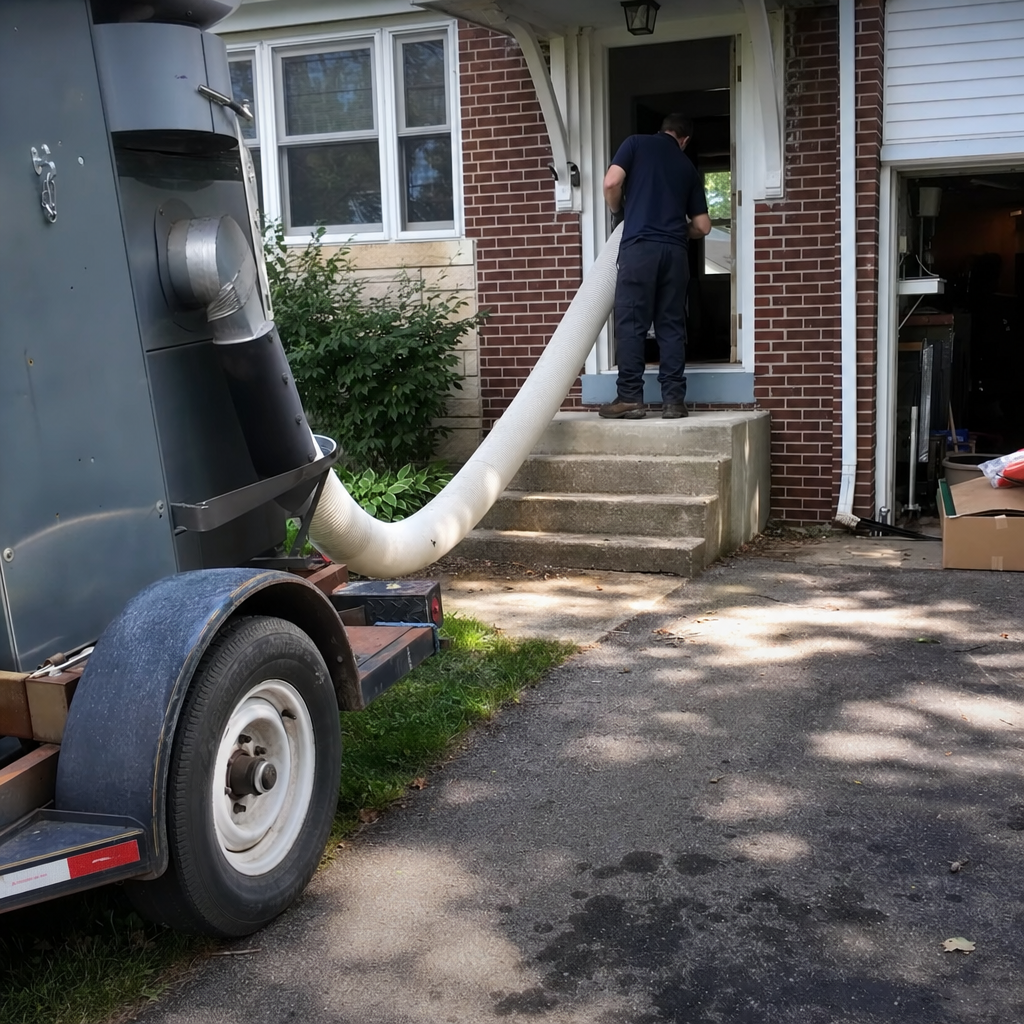
- Protective containment setup. The HVAC system is sealed off, registers are covered, and a HEPA-filtered negative air machine — we use Nikro and Abatement Technologies units — creates suction at the main trunk. This containment prevents debris migration during agitation.
- Mechanical agitation of each branch. Using Rotobrush rotary systems or compressed-air whips (selected based on duct material), we dislodge adhered debris from interior surfaces. In galvanized systems with rust scale, this step takes longer than the extraction itself.
- High-volume debris extraction. The negative air machine pulls dislodged material through the trunk and into a sealed collection system. We verify suction at each register to confirm no blockages or leaks are bypassing collection.
- Component cleaning. The blower wheel, evaporator coil (if accessible), and plenum receive dedicated cleaning — not just incidental vacuuming. These components recirculate air continuously; leaving them dirty defeats the purpose.
- Post-cleaning verification and documentation. We re-camera the system, seal access ports with permanent metal patches, and provide photo documentation. You’ll see exactly what we found and what we did — no guesswork, no upsell pressure.
The entire process takes 3–5 hours for a typical Youngstown home with 15–25 registers. Anyone in and out in 90 minutes skipped steps.
How Lake-Effect Humidity Affects Your Ducts
Youngstown’s position 20 miles from Lake Erie puts it in the path of persistent moisture-laden air masses, especially October through April. While Cleveland gets the headlines for lake-effect snow, our slightly inland location means sustained high humidity without the dramatic precipitation that actually removes moisture from the air column.
This matters for ductwork in specific ways:
- Dust compaction density. Moisture binds particulate to metal surfaces far more aggressively than in arid climates. In Youngstown, we’ve extracted dust cakes from galvanized trunks that required sustained mechanical agitation — the same debris type in a Phoenix system would have remained loose and blown out with moderate airflow.
- Surface mold colonization. Humid air passing through cool ductwork creates condensation on interior surfaces. In uninsulated basement trunks common in Youngstown’s older homes, we’ve documented Cladosporium and Penicillium growth on dust layers — not catastrophic contamination, but a legitimate air quality concern that responds to proper cleaning followed by EPA-registered sanitizing. We apply this only where indicated, not as a blanket upsell.
- Insulation degradation. Fiberglass duct liner, found in some 1970s and 1980s Youngstown builds, loses structural integrity faster in high-humidity cycling. Aggressive cleaning of degraded liner releases fibers into airflow. Our pre-inspection identifies this condition before tool selection.
The practical implication: Youngstown duct cleaning requires humidity-aware protocols that drier-climate franchises often don’t adjust. We factor local conditions into drying time, sanitizing decisions, and recommendations for dehumidification upgrades.
Pricing Red Flags in the Youngstown Market
The Mahoning Valley sees more than its share of itinerant duct cleaning operations — crews with out-of-state plates and 800 numbers that blanket neighborhoods with coupons, perform superficial work, and disappear before complaints accumulate. Here’s how to interpret quotes accurately:
| Pricing Model | Typical Youngstown Range | What It Actually Means |
|---|---|---|
| Per-vent pricing ($15–$40/register) | $300–$800 advertised | Often excludes trunk lines, returns, and blower cleaning — the bulk of the actual work. Final bills frequently double the advertised price. |
| Whole-house flat rate | $400–$900 | Legitimate when it includes all components, access ports, and post-cleaning verification. Ask for written scope. |
| “Whole house” specials under $300 | $99–$250 | Red flag. Cannot cover labor, equipment, and disposal costs for legitimate negative-pressure cleaning. These operations typically use shop vacs and skip containment. |
| Sanitizing/mold treatment add-ons | $200–$500+ | Legitimate only with pre-cleaning photo documentation of actual microbial growth. Blanket offers without inspection are upsell tactics. |
We’ve responded to Youngstown homes where a “$199 whole house” special left the system dirtier — the operator’s unfiltered shop vac blew debris through disconnected joints into wall cavities. 17 years, 661 reviews — the track record speaks for itself. Professional-grade Rotobrush and Nikro systems, not box-store equipment.
When Ducts Need Special Handling Before Cleaning
Youngstown’s industrial heritage creates specific pre-cleaning considerations that don’t appear in generic guides. Before standard agitation begins, we assess for:
Coal residue in pre-1960s systems. Homes that converted from coal to gas heating — common throughout Youngstown’s historic districts — often retain soot deposits in original ductwork. Standard brushes can redistribute fine particulate through the entire house. These systems need HEPA containment and sequential cleaning with specialized filtration, adding 1–2 hours to the job.
Asbestos-wrapped ducts and tape. Pre-1978 builds may have asbestos paper on duct exteriors or white woven tape at joints. Disturbing these materials during access creation releases fibers. We’re trained to identify and avoid disturbance; when found, we stop and recommend certified abatement before proceeding. This isn’t a sales tactic — it’s federal NESHAP protocol, and ignoring it exposes homeowners and technicians to liability.
Lead paint on register grilles. Original painted metalwork in Youngstown’s older homes often contains lead. We use wet methods and HEPA vacuuming during register removal, not dry scraping that creates airborne particulate.
From cleaning to repair to sealing — one call covers the full job. We don’t hand you off to third-party contractors for these contingencies.
How Often Should Youngstown Homes Get Duct Cleaning?
The NADCA (National Air Duct Cleaners Association) recommends cleaning every 3–5 years for typical residential systems. In Youngstown, we adjust this based on specific local factors:
- Homes with original galvanized systems near major roads (Market Street corridor, Meridian Road): Every 3–4 years due to higher particulate load from traffic and industrial legacy particulate in soils.
- Post-1970 homes with no pets, no smokers, no renovations: Every 5–7 years may suffice if filters are changed regularly and humidity is controlled.
- After any major renovation: Immediately, regardless of schedule. Construction dust bypasses even conscientious contractor containment and settles in ductwork.
- Homes with forced-air heating and central AC: More frequent attention to the evaporator coil and condensate pan, where Youngstown’s humidity creates biofilm buildup that standard duct cleaning alone won’t address. Our HVAC Cleaning in Youngstown service covers this specifically.
- Properties with persistent moisture issues: Address the moisture source first, then clean. Re-cleaning annually without fixing basement seepage or humidifier malfunctions wastes money.
We don’t sell annual “maintenance” duct cleaning — it’s unnecessary for most systems and suggests the initial job wasn’t thorough.
Common Mistakes to Avoid
- Hiring based on coupon price alone. The $199 “whole house” special in Youngstown almost always excludes trunk lines and uses unfiltered equipment. We’ve rebuilt customer trust after these operations more times than we can count.
- Assuming all duct materials can handle the same cleaning intensity. Flex duct in 1980s Boardman ranches tears under aggressive brushing; galvanized steel in 1940s Wick Park homes needs exactly that intensity. One protocol for all systems causes damage.
- Ignoring the dryer vent. In Youngstown’s humid climate, lint compaction in dryer vents accelerates fire risk and backs moisture into laundry spaces. Our Dryer Vent Cleaning in Youngstown addresses this specifically — it’s not included in standard duct cleaning.
- Accepting “mold” diagnoses without visual proof. Scare tactics about “black mold” in ducts drive unnecessary upsells. Legitimate microbial concerns are documented with borescope photos and laboratory confirmation, not flashlight beams and alarmist language.
- Cleaning without fixing underlying problems. Disconnected ducts, failed humidifiers, and basement moisture infiltration will recontaminate clean systems within months. We identify these during inspection and can repair before or during cleaning.
- Using unverified “sealant” or “encapsulant” products. Some operators spray unknown chemicals into ducts claiming improved air quality. EPA-registered sanitizers have specific application protocols; mystery coatings can off-gas for months.
- Neglecting post-cleaning filter upgrades. A clean system with a cheap fiberglass filter recontaminates in weeks. We specify appropriate MERV ratings for your equipment — typically MERV 8–11 for most Youngstown residential systems, never exceeding manufacturer specifications.
When to Call a Professional
Call for inspection — not necessarily full cleaning — when you notice visible dust emission from registers, uneven heating or cooling between rooms, musty odors that intensify when the system runs, or unexplained respiratory irritation that correlates with HVAC operation. In Youngstown’s older housing stock, also call before any renovation that disturbs original building materials, and after any water intrusion event affecting duct-adjacent spaces.
Coastal Air Duct & Vent Cleaning Greater Youngstown offers free estimates in Youngstown — call (866) 952-5794. Mark Thompson will inspect your specific system, explain what it needs (or doesn’t), and provide upfront pricing without same-day pressure to commit. We’ve walked away from jobs that didn’t need doing, and we’ll tell you honestly if your ducts are clean enough to wait.
Frequently Asked Questions
Complete residential air duct cleaning in Youngstown typically runs $400–$900 depending on system size, accessibility, and whether asbestos or coal residue handling is required. Per-vent pricing that seems cheaper usually excludes trunk lines and blower components. Call (866) 952-5794 for an exact quote — estimates are free.
Moderately, in specific circumstances. Clean blower wheels and evaporator coils restore designed airflow, which can reduce runtime. However, duct cleaning alone won’t fix poorly insulated ducts, oversized equipment, or leaky building envelopes common in Youngstown’s older homes. We assess whether cleaning or repair delivers better return during inspection.
A thorough job on a typical Youngstown home takes 3–5 hours. Octopus gravity systems or those requiring asbestos precautions may extend to a full day. Anyone completing “whole house” work in under two hours is skipping containment, trunk line access, or verification steps.
Standard agitation is not safe — it can release asbestos fibers. We inspect for asbestos paper and tape before beginning; if found, we stop and recommend certified abatement. This is non-negotiable and protects both occupants and technicians under federal regulations.
It can reduce airborne particulate load, especially if ducts contain significant dust, pet dander, or mold. However, duct cleaning is one component of indoor air quality management — source control (filtration, humidity management, pet grooming) typically matters more. We don’t oversell cleaning as a medical solution.
Air duct cleaning addresses the distribution network — trunks, branches, and registers. HVAC cleaning includes the mechanical components: blower wheel, evaporator coil, heat exchanger, and condensate system. In Youngstown’s humid climate, the coil and pan often need attention even when ducts are relatively clean. Our HVAC Cleaning in Youngstown service covers this scope.
The Bottom Line
Youngstown’s aging, diverse housing stock demands duct cleaning that adapts to galvanized steel, octopus gravity systems, and asbestos-era materials — not franchise protocols designed for suburban flex-duct builds. Legitimate service uses HEPA-filtered negative pressure with mechanical agitation, takes 3–5 hours, and costs $400–$900 for complete residential work. Verify your technician’s equipment, insist on photo documentation, and reject per-vent pricing that hides the true scope. For homeowners who want the most experienced person on every job, not a rotating subcontractor crew, Coastal Air Duct & Vent Cleaning Greater Youngstown home provides inspection, cleaning, repair, and sealing with owner-operator accountability.
Ready to find out what your Youngstown duct system actually needs? Call (866) 952-5794 for a free estimate with no same-day pressure. Mark Thompson will inspect your system personally and give you straight answers about whether cleaning, repair, or simply better filtration is the right next step.
Written by Mark Thompson, Owner & Lead Technician at Coastal Air Duct & Vent Cleaning Greater Youngstown, serving Youngstown since 2009.