
Air Duct Sanitizing Service in Youngstown, OH — From $275 to $550 Depending on System Size and Contamination Level
Air Quality & Sanitizing Near Me in Youngstown, OH runs $275–$550 for most residential systems, with whole-home treatments on original mid-century ductwork at the higher end. We complete most sanitizing jobs same-day, and we don’t start until we’ve run a mechanical cleaning with our Rotobrush and Nikro extraction systems first — sanitizing a dirty duct is like disinfecting a muddy floor. Call (866) 952-5794 for a free estimate and we’ll tell you honestly whether your system needs it.
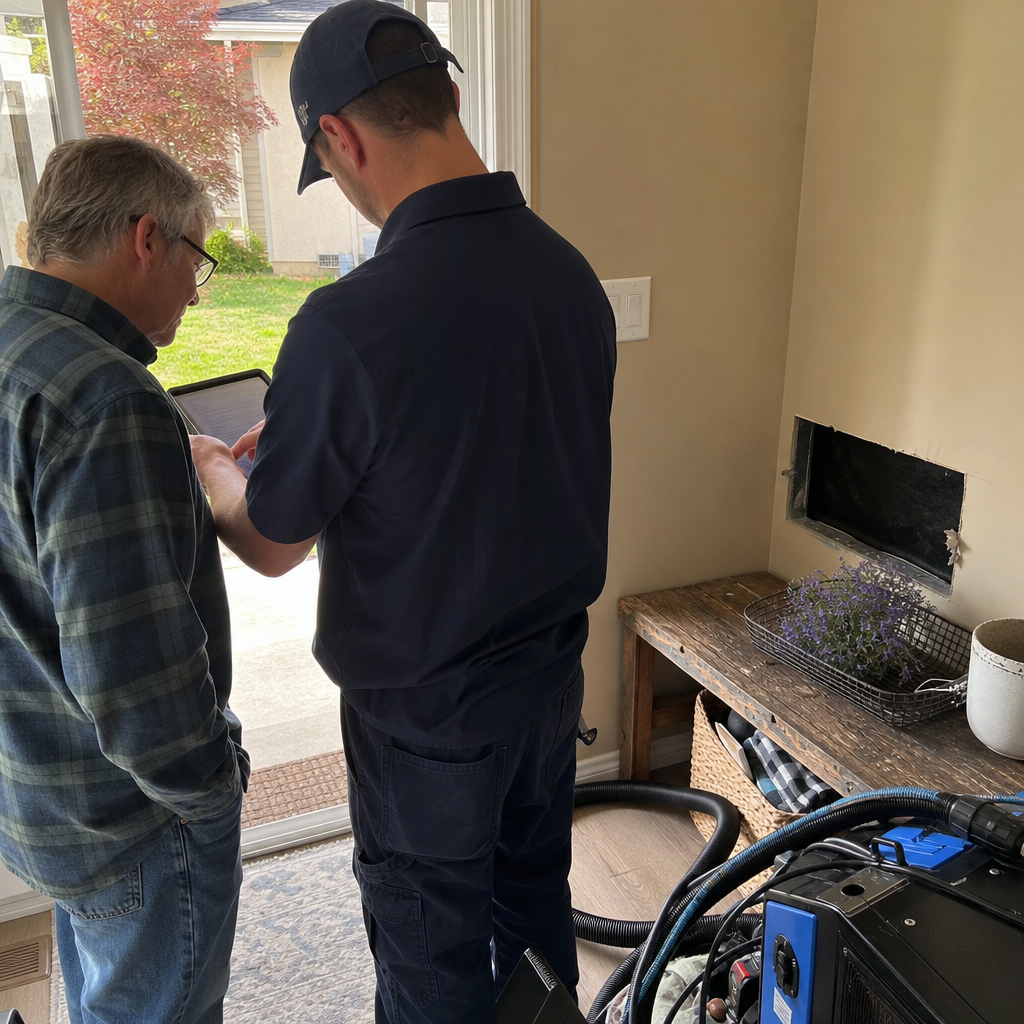
Here’s the situation we see constantly in Youngstown: a family picks up a Land Bank property on the South Side or Brier Hill, flips the heat on for the first time in three winters, and the house smells like a basement within the hour. Brushing and vacuuming removes the mouse nesting material, the coal soot, the insulation fragments — but the smell persists because mold colonies have established in the sheet metal and fiberboard, and they’re reactivating now that the system is warm. That’s when sanitizing becomes the baseline, not an upsell.
What Air Duct Sanitizing Actually Does — And What It Doesn’t
We need to be straight about this because the duct cleaning industry has muddied the water. Mechanical cleaning removes physical debris. Sanitizing addresses microbial contamination that survives after the debris is gone. They’re sequential, not interchangeable.
In a typical Youngstown vacant-home scenario — and we’ve done hundreds in neighborhoods from Oak Hill to the lower West Side — we’ll pull out remarkable material with our Rotobrush and Nikro systems: layered rodent nesting, steel-era coal soot that predates the forced-air conversion, sometimes water-damaged insulation that collapsed into the return. But once that’s extracted, the sheet metal still carries mold species that survived multiple freeze-thaw cycles. Those colonies don’t brush off.
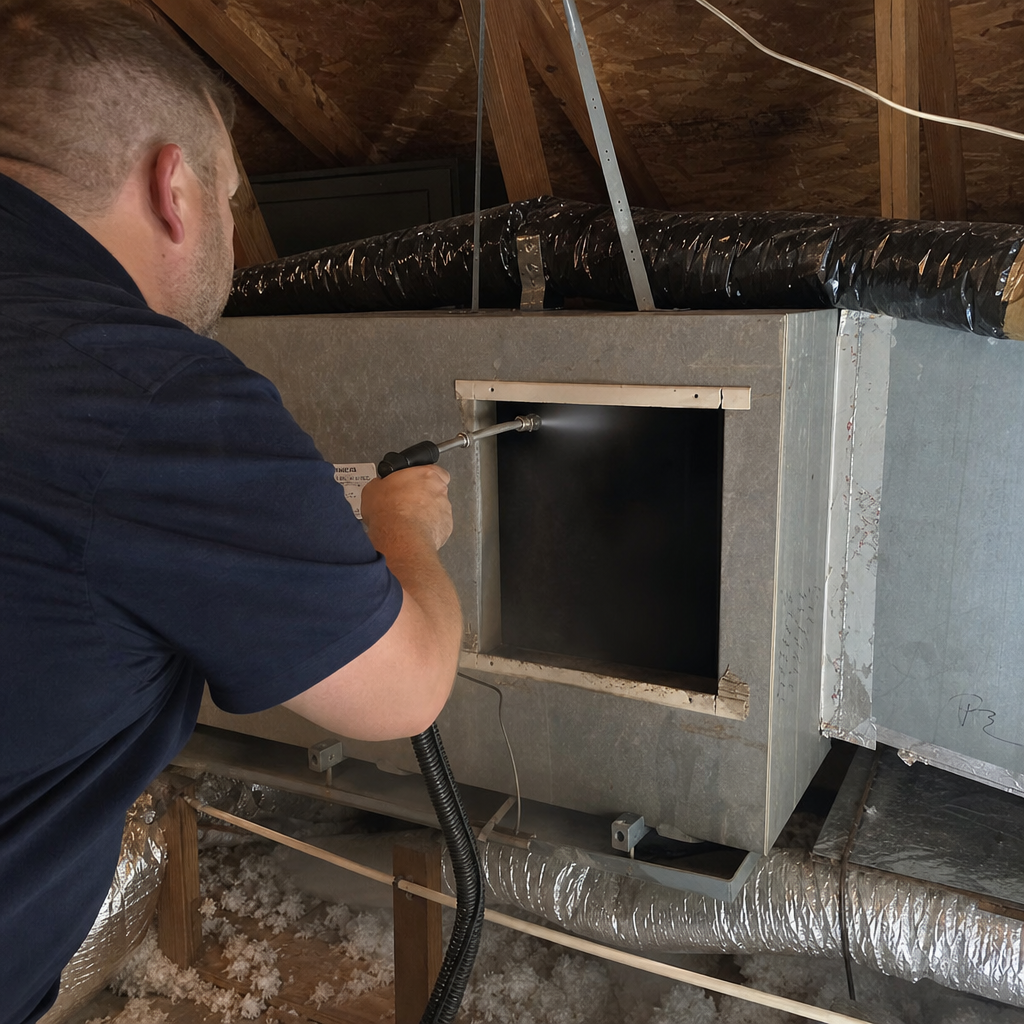
Our sanitizing service applies an EPA-registered antimicrobial agent through controlled fogging equipment, not a handheld spray bottle. The fogger generates particles small enough to follow the air stream into branch lines and boot connections that physical tools can’t reach. It contacts the full interior surface — supply and return trunks, branch ducts, boots, and the plenum — and remains active on surfaces after application.
What it does not do: penetrate solid debris, fix water intrusion problems, or compensate for ductwork that needs physical repair. If your plenum is rusted through or your flex duct is collapsed, fogging won’t help. We’ll tell you that before we start. “If it needs doing, I’ll tell you. If it doesn’t, I’ll tell you that too.”
How We Run the Sanitizing Process
- Mechanical cleaning first with Rotobrush contact cleaning and Nikro negative-air extraction
- Abatement Technologies HEPA air filtration deployed during sanitizing to capture aerosolized spores displaced by the fogging process
- EPA-registered antimicrobial fogging throughout the complete duct network, with dwell time per manufacturer specification
- System airflow test post-treatment to confirm unrestricted distribution
- Visual documentation of before/after conditions for the homeowner’s records
The Abatement Technologies filtration matters more than most homeowners realize. In a Land Bank flip where someone’s moving in within 48 hours, the last thing you want is spores circulating during the treatment itself. We run that filtration continuously, and we don’t consider the job complete until airborne particulate counts drop to baseline.
Why Youngstown’s Housing Stock Makes Sanitizing More Necessary Here
Youngstown’s dominant housing — the 1910s-to-1940s brick and frame worker housing built for steel and manufacturing employees — carries a specific ductwork profile that amplifies contamination risk. Most of these homes were converted from coal or oil gravity systems to forced air during the 1950s–1970s. Those conversions frequently left soot deposits in trunks that were never fully cleaned, and they often used undersized duct runs that trap debris and resist standard cleaning equipment.
When one of these homes sits vacant through multiple winters — and Youngstown’s decades of population loss since the 1977 mill closures left thousands in exactly that condition — the combination is severe. Technicians working estate sales or Land Bank properties commonly find ductwork packed with mouse nesting layered over coal soot, in systems that went unheated long enough for condensation to promote mold growth throughout.
The climate makes it worse. Youngstown sits in the lake-effect snow belt despite being 75 miles from Lake Erie. Persistently high winter humidity and frequent freeze-thaw cycles create condensation inside older, uninsulated ductwork. In a heated, occupied home, that moisture often dries before colonies establish. In a vacant home with no heat, it doesn’t dry — it freezes, thaws, and promotes mold species that survive low temperatures and reactivate aggressively when warmth returns.
We’ve treated systems in original mid-century ductwork on the West Side where the contamination was so established that the first heat cycle of fall sent visible particulate through registers. That’s not a cleaning job. That’s a cleaning-plus-sanitizing job, and anyone who tells you otherwise hasn’t opened enough of these systems.
Sanitizing for Occupied Homes — Not Just Vacant Properties
Here’s what our competitors’ pages almost never mention: Youngstown’s humidity affects maintained, occupied homes too. If your house has older uninsulated ductwork — and most in the 44502, 44509, and 44510 ZIPs do — microbial growth can develop over time even with regular filter changes.
The telltale signs we look for on occupied-home calls:
- Persistent musty odor when the furnace or AC first cycles on, especially after humid summer weather
- Return-air runs near crawl spaces or exterior walls where temperature differential creates condensation
- Previous water intrusion in the basement or crawl space that may have affected duct runs
- Family members with unexplained respiratory irritation that improves when away from home
We don’t sell sanitizing to every occupied home we visit. Sometimes the ducts are genuinely clean enough that mechanical extraction is sufficient. But when we scope a system and find active growth in the return trunk — which we can show you on camera — sanitizing is the appropriate next step, not a luxury add-on.
What Sanitizing Costs in Youngstown — Structured Pricing
Our pricing reflects system size, accessibility, and contamination level. These are actual ranges we quote for residential work in the Youngstown metro:
| Service Component | Price Range |
|---|---|
| Air duct sanitizing (standard residential, up to 15 vents) | $275 – $375 |
| Air duct sanitizing (large residential, 16–25 vents) | $375 – $475 |
| Air duct sanitizing (whole-home with original mid-century ductwork, complex layout) | $475 – $550 |
| Mechanical cleaning + sanitizing package (recommended for vacant/neglected systems) | $450 – $650 |
| HVAC coil and blower sanitizing add-on | $125 – $175 |
| Post-sanitizing air quality verification with particle counter | $75 – $95 |
Vacant-home systems in Land Bank or estate-sale properties typically require the cleaning-plus-sanitizing package because of the layered contamination we described. We’ll assess this during your free estimate and quote accordingly — no surprise charges after we start.
Common Local Scenarios We Handle
Over 17 years and somewhere north of two thousand homes in the Mahoning Valley, these are the situations that actually drive sanitizing calls in Youngstown. Not hypotheticals — patterns we see repeatedly.
The Land Bank Flip
Property acquired through the Mahoning County Land Bank, often after five or fifteen years of vacancy. The investor cleans visibly, runs the heat, and calls us when the smell won’t clear. We open the system and find the layered contamination: rodent debris, collapsed insulation, coal-era soot, and mold established throughout. Cleaning removes the bulk; sanitizing addresses what remains. We typically complete these in one day with our Air Quality & Sanitizing protocol.
The Estate Sale with Deferred Maintenance
Elderly owner, house sold as-is, ductwork untouched since the 1980s conversion. Family members notice respiratory irritation when sorting belongings. We scope the system and find restricted airflow from debris accumulation plus active growth in the humid return sections. Cleaning restores airflow; sanitizing makes the system safe for the new occupants.
The Occupied Home with Persistent Humidity Issues
Homeowner in an older neighborhood — Oak Hill, Crandall Park, the West Side near Mill Creek Park — has dealt with musty odors for years. Previous duct cleaning helped temporarily but the smell returned. We inspect and find that the original uninsulated returns run through a damp basement or crawl space, creating chronic condensation. After cleaning, sanitizing breaks the cycle; we may also recommend duct sealing or insulation to prevent recurrence.
The Post-Remediation Verification
Mold remediation company has addressed the source — roof leak, foundation intrusion — and cleared the living space. But the HVAC system ran during the active growth period, distributing spores through the duct network. We clean and sanitize to complete the remediation chain, with documentation for insurance or real estate disclosure purposes.
Why Equipment Matters — And What We Use
We’ve seen competitors attempt sanitizing with garden sprayers and consumer-grade antimicrobial products. That doesn’t reach branch lines, doesn’t maintain proper dwell time, and doesn’t protect against aerosolized spores during treatment.
Our equipment for sanitizing work includes:
- Professional fogging systems that generate appropriately sized particles for duct distribution
- Abatement Technologies HEPA-negative air machines for continuous spore capture during treatment
- Rotobrush contact cleaning systems for pre-sanitizing mechanical extraction
- Nikro high-velocity extraction equipment for debris removal
The fogging particle size matters technically: too large, and the agent pools in low spots without reaching upper branch lines. Too small, and it doesn’t deposit on surfaces effectively. We calibrate equipment per system layout — another reason Mark Thompson handles your job personally rather than delegating to rotating subcontractors.
FAQs
Air duct sanitizing service in Youngstown typically costs $275–$375 for standard residential systems up to 15 vents, $375–$475 for larger homes with 16–25 vents, and $475–$550 for whole-home systems with original mid-century ductwork — see our full air quality sanitizing cost guide for Youngstown, OH for details. The cleaning-plus-sanitizing package most vacant-home situations require runs $450–$650. Call (866) 952-5794 for a free exact quote — estimates are free and we’ll tell you honestly if your system needs it.
No — and we won’t. Sanitizing over physical debris is ineffective because the antimicrobial agent can’t contact the actual duct surface. In Youngstown’s vacant-home market, we regularly find systems with enough bulk contamination that cleaning alone takes a full session before sanitizing can begin. Anyone offering sanitizing without pre-cleaning is selling you a product, not a solution.
The system is safe to operate immediately after our protocol is complete — we don’t use products requiring extended vacancy periods. For Land Bank flips or estate sales where new occupants are moving in quickly, we run Abatement Technologies HEPA filtration during treatment to capture displaced spores, and we verify airborne particulate levels before we leave. Most homeowners resume normal use the same day.
It’s worth it when microbial growth is present, regardless of occupancy status, and we aim to provide the best air quality sanitizing in Youngstown, OH. In Youngstown, we’ve sanitized occupied homes in neighborhoods throughout the 44502, 44509, and 44510 ZIPs where persistent humidity in older uninsulated ductwork created active growth — especially in return-air runs near crawl spaces or exterior walls. We scope first; if we don’t find growth, we’ll tell you sanitizing isn’t needed. Call (866) 952-5794 to schedule an assessment.
Ready to Find Out What Your Ducts Actually Need?
Seventeen years, 661 reviews, and Mark Thompson on every job — that’s the track record. We’ll scope your system, show you what we find, and tell you straight whether sanitizing is necessary or if cleaning alone will handle it. No upsell pressure, no mystery about the work. Call (866) 952-5794 for your free estimate today.
Written by Mark Thompson, Owner & Lead Technician at Coastal Air Duct & Vent Cleaning Greater Youngstown, serving Youngstown, OH.