
Honeywell Air Duct Cleaning in Youngstown: A Homeowner’s Guide
Honeywell doesn’t manufacture duct cleaning equipment — they make the air quality components installed inside your HVAC system that must be serviced alongside a duct cleaning, not treated as an afterthought. In Youngstown, we regularly find homeowners who’ve paid for duct cleaning only to discover their Honeywell electronic air cleaner was never touched, rendering half the job ineffective. If you’re sorting out whether you need duct cleaning, Honeywell component service, or both, Coastal Air Duct & Vent Cleaning Greater Youngstown home handles the full sequence — call (866) 952-5794 for a free estimate.
What Honeywell Equipment Actually Lives Inside Your Duct System
Youngstown homes built from the 1980s through the mid-2000s often have Honeywell components the original owner installed and the current owner barely knows exists. We’ve walked into houses in Boardman and Austintown where the homeowner thought they had a “standard filter” and were running a Honeywell F300 Electronic Air Cleaner the whole time — dead cells and all.
Here’s what we commonly encounter in Youngstown HVAC systems:
- Honeywell Electronic Air Cleaners (F300, F50A series): These mount in the return air plenum and use charged cells to trap particles. The cells need periodic washing, and the ionizing wires require inspection for breakage. When they’re dirty or non-functional, they restrict airflow and stop filtering.
- Honeywell Media Air Cleaners (F100, F200): Box-style filters with replaceable media, typically 4–5 inches thick. The cabinet itself needs cleaning when we do ductwork — replacing the media without cleaning the housing defeats the purpose.
- Honeywell Whole-Home Humidifiers (HE360, HE365): Common in Youngstown’s older neighborhoods like Liberty and Struthers, where winter air is brutally dry. The water panel, distribution tray, and drain line accumulate scale and biological growth that can contaminate clean ducts if not addressed.
- Honeywell UV Germicidal Lights: Installed near the evaporator coil to control mold and bacteria. The bulbs degrade — 9,000 hours is typical useful life — and a dim or dead UV light is just a warm tube doing nothing.
Each of these interacts with airflow and contamination in ways that affect, and are affected by, the condition of your ductwork. That’s the connection most competitors miss.
Why Your Honeywell Air Cleaner Can’t Be Ignored During Duct Cleaning
Here’s a scenario we’ve seen a dozen times in Youngstown: A homeowner hires a cut-rate duct cleaning crew. They run a brush and vacuum through the trunk lines, pack up, and leave. The Honeywell F300 in the return plenum? Never opened. The pre-filter’s clogged with dog hair, the cells are caked with a decade of residue, and the ionizing wires are broken in two places.
Two weeks later, the homeowner calls us wondering why they’re still dusting every other day and their allergies haven’t improved.
The problem is airflow physics. Your return plenum is where air enters the system. If the Honeywell cleaner mounted there is clogged or non-functional, it becomes the bottleneck. Clean downstream ducts don’t matter when the return side is still forcing air through a contaminated restriction. Worse, a dirty electronic air cleaner can actually become a particle source — breaking down accumulated gunk and re-distributing it.
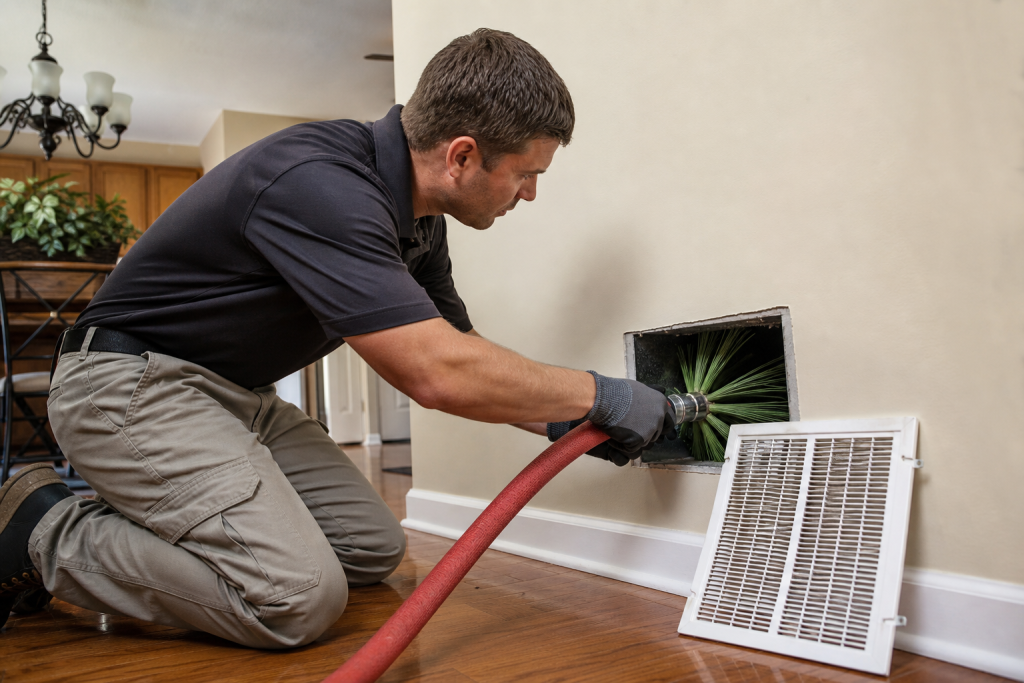
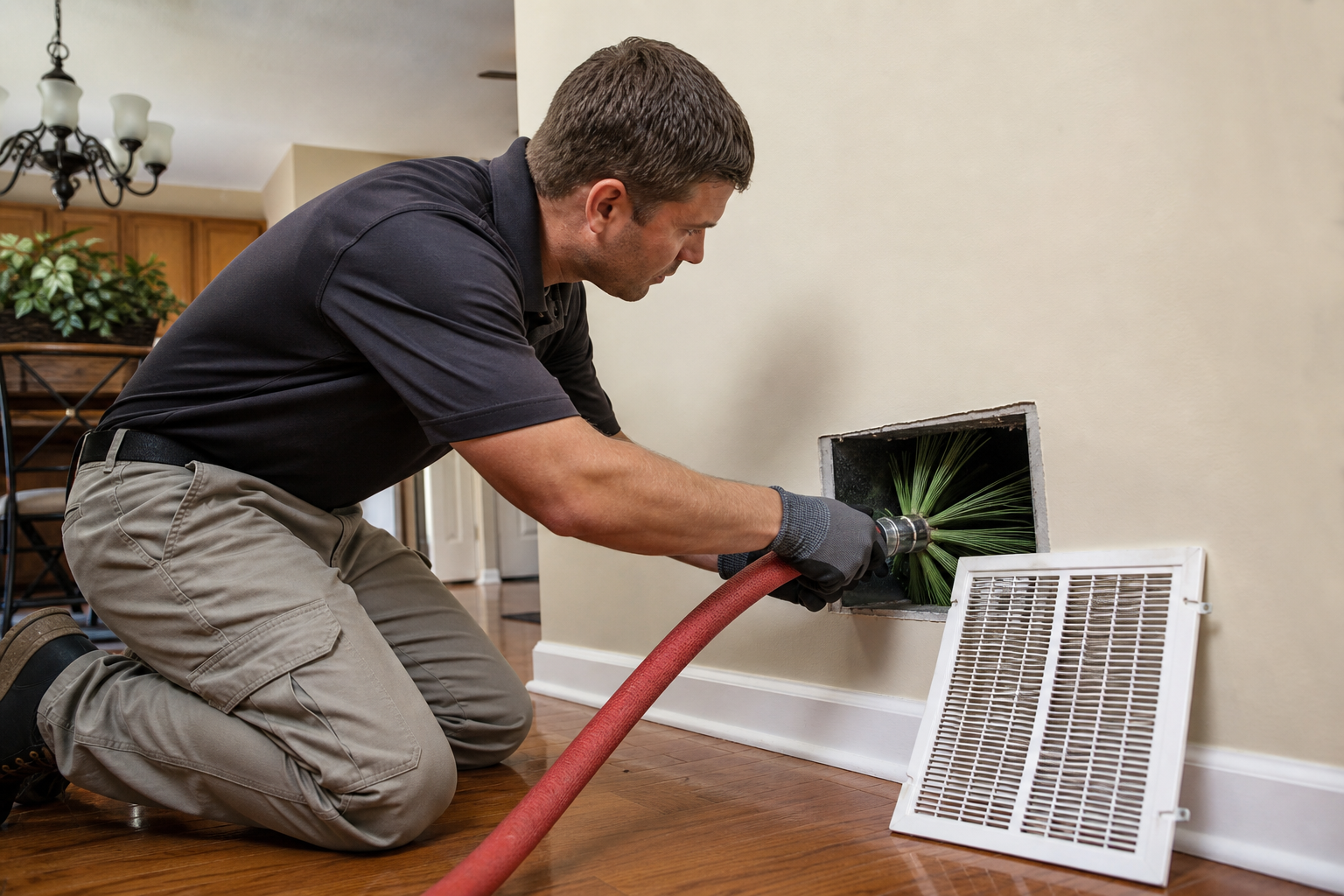
Our process with Rotobrush and Nikro extraction systems includes pulling and inspecting the Honeywell cabinet as a standard step. We clean the housing, assess the cells or media, and flag anything that needs replacement. In our experience, about 40% of Youngstown homes with Honeywell electronic cleaners have at least one broken ionizing wire the homeowner never knew about.
The Correct Service Sequence: Ductwork First, or Honeywell First?
Order matters, and we’ve refined this over 17 years of owner-operated work in Youngstown.
Step one: Inspect and service the Honeywell air cleaner or humidifier before touching the ducts. We need to know if the component is functional, partially functional, or dead. A failed electronic air cleaner with shorted cells can restrict airflow enough that our cleaning equipment readings are inaccurate — we’ll think we have a blockage in the ducts when it’s actually the cleaner.
Step two: Clean the duct system with the Honeywell component either removed (electronic cells) or bypassed (media cabinet opened). This prevents our agitation equipment from driving debris deeper into the cleaner’s sensitive components.
Step three: Reinstall and test the Honeywell unit, verifying airflow draw and — for electronic models — that the power indicator shows proper ionization voltage. We document before-and-after static pressure readings so you see the difference.
Skip this sequence and you’re gambling. We’ve rescued jobs in Canfield where a previous contractor cleaned ducts with a humidifier water panel still installed, turning it into a soggy debris trap that grew mold within a month.
Is Your Honeywell Electronic Air Cleaner Actually Working? Here’s How to Check
Youngstown’s housing stock includes plenty of inherited HVAC setups. The previous owner may have installed a top-tier Honeywell F300 in 2005, then never maintained it. You move in, see the cabinet, assume it’s doing something.
Quick checks anyone can do — safely, with the system powered down:
- Listen for the snap: When your blower starts, a functioning Honeywell electronic cleaner produces an audible, irregular snapping as particles hit the cells. Silence means no high voltage — dead power supply, tripped safety switch, or failed transformer.
- Check the indicator light: Most F300 units have a small neon or LED indicator visible through the door. Steady glow is good; flickering or dark suggests problems.
- Inspect the pre-filter: Remove the door (usually two thumb latches). The pre-filter should be dirty — that’s its job. If it’s pristine after six months of runtime, air is bypassing it through a gap or the system’s not drawing through the cleaner at all.
- Look for cell corrosion: The aluminum collection cells should be intact. White powdery buildup or bent plates indicate it’s time for replacement — cleaning won’t restore conductivity.
Found something concerning? That’s when to call. We pulled a unit in a garage over in Poland last month where the cells had corroded so badly they were shedding aluminum oxide into the airflow. The homeowner’s “allergy season” turned out to be metal particulate irritation. Mark Thompson handles your job personally — owner on-site, every time — so we catch things like that, not blow past them.
Questions to Ask Any Duct Cleaning Contractor About Honeywell Components
Not every duct cleaning operation in Youngstown knows what to do with a Honeywell F300. Some treat it as an obstacle to work around. Here’s how to separate the knowledgeable from the just-equipped:
- “Will you remove and inspect my Honeywell electronic cells, or clean around them?” The correct answer is removal, cleaning, inspection, and reinstallation — not “we don’t touch that.”
- “Do you check ionizing wire condition, or just wash the cells?” Broken wires are invisible once the cells are reassembled. A proper service includes wire inspection.
- “If my Honeywell unit is failed, will you tell me before or after the duct cleaning?” Before. Always before. You may choose to replace it and re-clean, or accept limited results.
- “What static pressure readings do you take, and where?” Any technician worth hiring measures return and supply static pressure before and after. If they don’t own a manometer or don’t know what you’re asking, keep looking.
- “Do you service humidifiers and UV lights, or do I need a separate HVAC contractor?” We handle the full scope — cleaning, HVAC service, duct repair and sealing, and air quality sanitizing — because splitting the job between vendors guarantees something gets missed. From cleaning to repair to sealing, one call covers the full job.
Professional-grade Rotobrush and Nikro systems, not box-store equipment, plus Abatement Technologies air filtration for containment — that’s the standard we bring. See exactly what we found and what we did — no guesswork, no upsell pressure.
Related services in Youngstown: If your Honeywell humidifier needs more than cleaning, or your full HVAC system requires attention, see our HVAC Cleaning in Youngstown page. For dryer vent issues that compound indoor air quality problems, check Dryer Vent Cleaning in Youngstown.
The Bottom Line
Honeywell makes components that live inside your air handling system, not duct cleaning tools. In Youngstown’s climate — hot, humid summers and winters that run furnaces hard for five months straight — those components work constantly and accumulate contamination that a duct cleaning alone won’t address. The most effective service sequence inspects and services your Honeywell equipment first, cleans the duct system second, and verifies everything together third. Anything less leaves performance on the table and can re-contaminate fresh ductwork within weeks.
17 years, 661 reviews — the track record speaks for itself. If you’re in Youngstown and need help sorting out whether your Honeywell equipment, your ductwork, or both need attention, Coastal Air Duct & Vent Cleaning Greater Youngstown offers free estimates. Call (866) 952-5794 and Mark Thompson will walk through what we actually find in systems like yours.
Frequently Asked Questions
No. Honeywell manufactures indoor air quality components — electronic air cleaners, media filters, humidifiers, UV lights, and smart thermostats — that install inside your HVAC system. They do not produce duct cleaning brushes, vacuums, or agitation equipment. Confusing the two leads homeowners to think a “Honeywell cleaning” is a specific service, when in reality it means servicing Honeywell components during a standard duct cleaning.
Whole-home duct cleaning in Youngstown typically runs $400–$700 for a standard single-system residence, with Honeywell component inspection and basic cleaning included in our process. If electronic cells need deep cleaning, wire replacement, or the unit has failed and needs removal, costs adjust accordingly. Every home in Youngstown is different — call (866) 952-5794 for an exact quote; estimates are free.
You can wash the cells in a sink with mild detergent — Honeywell’s manual covers this. However, inspecting ionizing wires for breakage, testing high-voltage output, and checking for cabinet air leaks requires tools and experience. We’ve found that homeowners who DIY the cleaning often reassemble cells incorrectly, bending plates and creating shorts that damage the power supply. For a full assessment, a trained technician is the safer route.
It depends on your priorities and what’s failing. Electronic cleaners trap smaller particles (down to 0.3 microns when working) but require maintenance. Media filters are simpler but have higher ongoing replacement costs. In Youngstown, where pollen counts spike in late spring and mold is a concern in older homes, a functioning electronic cleaner has advantages — but a dead one is just a restriction. We assess yours honestly and explain both paths, no pressure either way.
Ask the specific questions listed above — removal versus working around, wire inspection, static pressure readings, and whether they handle humidifiers and UV lights. If they hedge or don’t understand the terminology, they’re likely treating your Honeywell cabinet as an obstacle rather than an integrated component. The contractor should explain their sequence clearly, not rush past it. Call (866) 952-5794 if you’d like to walk through our process directly.
Written by Mark Thompson, Owner & Lead Technician at Coastal Air Duct & Vent Cleaning Greater Youngstown, serving Youngstown since 2009.
Need Air Duct Cleaning Help?
Call Coastal Air Duct & Vent Cleaning Greater Youngstown — licensed & insured, here with fast after-hours help in Youngstown.
(866) 952-5794